 Robine Studio
Treble Booster
Boost · Circuit · Bronze
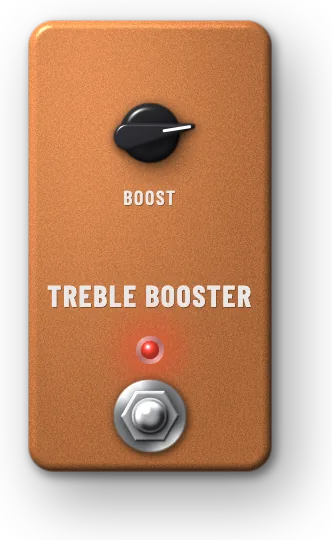
The real engine of the app, compiled for the browser, plays a recorded guitar (DI) through this pedal, then a clean amplifier and its cabinet. Turn the knobs (drag, scroll or use the arrow keys) and press the footswitch to hear it on and off. DI phrases by TONE3000, for now.
A germanium transistor and a small input capacitor: it lets the treble in and pushes the amplifier with it.
One knob, and the amp wakes up. Put it in front of an amp that is already on the edge of breaking up: the guitar jumps forward, the bass thins out, the top end and the upper mids come up, and the amp is pushed into a sweet, singing grit it would not give you on its own. On a dark amp or with humbuckers, it is what lets the notes through.
Its story
There is no single pedal behind it: it is written after the one-transistor germanium boosters of the 1960s. In the middle of that decade, British valve amps such as the Vox AC30 and the Marshall JTM45 could sound dark and muddy when pushed, above all with humbuckers. The fix was a small box in front of the amp that boosted the treble, with one germanium transistor that added its own distortion and overtones.
The best known is the Dallas Rangemaster Treble Booster, made from 1965 by Dallas Musical Ltd in London, by an engineer nobody has named. A grey folded metal box with a switch and a Boost knob, a Mullard OC44 transistor, nine components counting the potentiometer, a 9 V battery inside. It was meant to sit on top of the amp, not on the floor: its output cable was wired in and went straight into the amp. Rory Gallagher, Brian May, Tony Iommi, Marc Bolan and Billy Gibbons used one. The story that Eric Clapton played one with John Mayall’s Blues Breakers has never been confirmed: no Rangemaster shows in the photos of those sessions.
Cleaner, higher-fidelity amps and floor pedals put it out of fashion, then demand came back. Its circuit is simple and originals are rare: it has been cloned many times.
The variant you play
The Treble Booster is written for robine-spice after those boosters: a PNP germanium transistor on a positive ground, an input capacitor of 5 nF, small enough to let mostly the treble in, and the level taken from the transistor’s collector load. Boost is that load itself, the output on its wiper.
It is in the library for what the transistor’s own model adds to such a stage:
- its junction capacitances: the one between collector and base is multiplied by the gain of the stage (the Miller effect), and its 30 pF becomes a couple of nanofarads at the base, against the 5 nF input capacitor;
- the charge it stores when it conducts, which is what makes a germanium transistor slow;
- its Early voltage, which lowers the gain a little.
The transistor’s values are in the range of an OC44, not measurements of one. In the library it is the Treble Booster, among the boosts.
robine-spice also holds a netlist of the Dallas Rangemaster itself, written from its published schematic, which takes its transistor model from this booster. The two share every part and every value; they differ only by where Boost starts (0.8 here, 1 there). The app plays the Treble Booster.
What it is not:
- a measured pedal: its transistor is no measured OC44, and the germanium of one unit differs from the next;
- a real battery: the 9 V is ideal.
To start
- Boost at 0.8, where it starts, in front of the AC30 Top Boost or one of the JCM800s, the amp set just at the edge of breaking up.
- Boost lower: less level reaches the amp, and it pushes it less.
The circuit
One line per part: its name, the nodes it connects, its value (5e-9
is 5 nF, 4.7e5 is 470 kΩ). Q1 is the transistor (collector, base,
emitter), its model on the .model line: CJE and CJC its junction
capacitances, TF and TR the charge it stores, VAF its Early
voltage. PBoost is the potentiometer, its two ends on the collector and
on the supply, the output on its wiper.
Robine treble booster
* Written for robine-spice, after the one-transistor germanium boosters of
* the 1960s: a PNP on a positive ground, an input capacitor small enough to
* let only the treble in, and the level taken from the collector load.
* It is here for what the transistor's own model adds to such a stage:
*   - its junction capacitances. The collector-base one (CJC) is multiplied
*     by the gain of the stage, which is the Miller effect: 30 pF becomes a
*     couple of nanofarads at the base, against a 5 nF input capacitor;
*   - the charge it stores when it conducts (TF, TR), which is what makes a
*     germanium transistor slow;
*   - its Early voltage (VAF), which lowers the gain a little.
* The values are in the range of an OC44 and are not measurements of one.
* Boost is the collector load itself: the output is its wiper.
Vin in 0 DC 0
C1 in b 5e-9
R1 vee b 4.7e5
R2 b 0 6.8e4
Q1 c b e oc44
R3 e 0 3.9e3
C2 e 0 4.7e-5
PBoost c w vee 1e4 taper=log pos=0.8
C3 w out 1e-8
Rload out 0 1e6
Vee vee 0 DC -9
.model oc44 PNP(IS=1.5e-6 BF=75 BR=5 VAF=40 TF=1e-8 TR=1e-6 CJE=4e-11 CJC=3e-11)
.input Vin
.output out
Measured against
No real pedal: the Treble Booster claims to be none. It is measured against ngspice, the reference simulator, on the same circuit and the same signal: −41.9 dB at 48 kHz, −66.4 dB at 192 kHz, and its knob agrees with it. The tests of robine-spice also hold it to ngspice’s output.
The Rangemaster netlist, the same circuit at the same Boost positions, was compared with six captures of a British Pedal Company Rangemaster by alemarfra (TONE3000 #45843), named after the knob’s clock position, from 7 o’clock (0) to 5 o’clock (1). The captures do not give their input level: one was fitted once, on the “max” capture (2.0 V for a full-scale signal), and held. These captures are not ours to share: we name them, we do not distribute them.
| Capture | Boost | Difference (pre-emphasised ESR) | Disturbed frames | PEAQ (ODG) |
|---|---|---|---|---|
| rangemaster1200 | 0.5 | −8.27 dB | 83.43 % | −2.406 |
| rangemaster1300 | 0.6 | −8.41 dB | 81.11 % | −2.298 |
| rangemaster1400 | 0.7 | −8.43 dB | 81.48 % | −2.447 |
| rangemaster1500 | 0.8 | −8.13 dB | 83.22 % | −2.326 |
| rangemaster1600 | 0.9 | −8.14 dB | 76.75 % | −2.056 |
| rangemastermax | 1.0 | −7.82 dB | 75.81 % | −2.291 |
None is close: a setting counts from −10 dB and a PEAQ of −2, and every one misses on both counts, by 1.57 to 2.18 dB on the difference and by 0.056 to 0.447 on PEAQ. That is the Rangemaster’s grade (bronze, score 46.3), not this booster’s.
Its grade
Bronze, score 85.9. The maths is right: it follows ngspice, and its knob agrees with it. Its score alone would be gold; it is held at bronze because no real device has been compared with it (the grade says: 0 of 1 settings close to a real device). The one comparison of this circuit with a real pedal, under the Rangemaster’s name, found it short of close at every setting.
Sources: Dallas Rangemaster Treble Booster (Wikipedia), Dallas Rangemaster Treble Booster Analysis (ElectroSmash, archived copy), Rangemaster treble booster captures by alemarfra (TONE3000).