 Robine Studio
Humbucker
Boost · Built-in processing
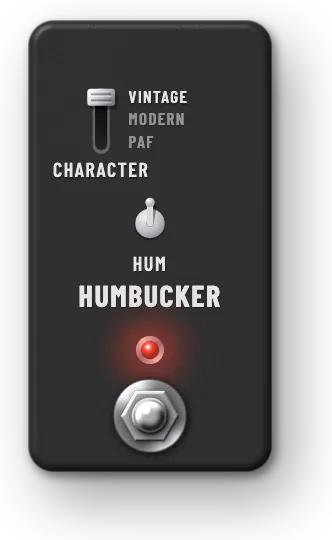
A single-coil guitar heard as a humbucker: its resonance moved down, the string heard from two points as two coils hear it, and more level. Character picks the kind of humbucker, Vintage, Modern or PAF: each has its own resonance, its coils a little closer or further apart, and its own level, Modern the loudest. Hum takes the mains hum off, 50 Hz or 60 Hz with their harmonics, without touching a note: a humbucker has none, a single coil under it still does. A note held steady exactly on a harmonic, such as 100 Hz, is taken for hum.
For the moment a single coil is too thin. Plug in a Strat-style guitar, switch it on, and the glassy top steps back: the notes get rounder and heavier, the pick’s click softens, and everything after it is pushed harder, a drive or an amplifier on the edge. A riff that needs weight, a lead that should sing instead of sting. And the buzz a single coil picks up from the mains goes with it.
Its story
A single-coil pickup is also an antenna: it hears the mains as well as the strings. The cure was known early. In the 1930s Electro-Voice, Arnold Lesti and, for pianos, Baldwin’s A. F. Knoblaugh each put two coils together so that the hum in one cancels the hum in the other. The one that lasted came from Gibson.
At Gibson, under its president Ted McCarty, the engineer Seth Lover worked on it through 1954, and by early 1955 the design was done: two coils side by side, wound in opposite directions over magnets of opposite polarity, wired in series. The strings add up, the hum cancels. Gibson and Lover filed the patent in June 1955; until it was granted, on 28 July 1959 (US 2,896,491), each pickup carried a decal underneath, “Patent Applied For”. That is why the first ones are still called PAF. Meanwhile Ray Butts had made his own humbucker for Gretsch, the Filter’Tron, and his patent was granted about four weeks before Gibson’s.
The PAF went onto lap steels in 1956 and onto guitars shown at the NAMM show in 1957, the Les Paul Goldtop and Custom first among the solid bodies. In 1958 the Goldtop gave way to the sunburst Les Paul Standard, and the pickups of those few years became the sound people chase: warm lows, clear mids, no hum, and an answer to the touch through an overdriven amplifier. Eric Clapton, Jeff Beck, Duane Allman, George Harrison and Sister Rosetta Tharpe played them. No two are quite alike: Gibson wound them on four machines, two without an automatic stop, and charged the magnets in batches, so the turns and the magnetism vary from one to the next. The humbucker also took the place of Gibson’s earlier pickup, the P-90 (the library’s P90 plays that one).
The variant you play
No particular pickup. There is no netlist behind the Humbucker, and no pickup was measured for it: it is processing the engine does itself, built from two textbook guitars of robine-spice, a single coil and a humbucker, each a pickup, its controls full up and 3 m of cable into a 1 MΩ input.
It assumes what reaches it is a single coil, with its resonance already in the sound. It takes that resonance off, puts a humbucker’s in its place, hears the string from two points as the two coils of a humbucker do, and adds level. Linear and mono: it does not saturate on its own, it feeds what comes after harder.
Character has three positions. Their names say how they are ordered, not what they were measured on: the numbers are a first guess, chosen to be distinct and in that order.
| Character | Humbucker’s inductance | Its resonance | Coils apart | Level |
|---|---|---|---|---|
| Vintage (0) | 9 H | near 2.2 kHz | 20 mm | +3 dB |
| Modern (0.5) | 6.3 H | near 2.6 kHz | 15 mm | +9 dB |
| PAF (1) | 7.65 H | near 2.4 kHz | 18 mm | +5 dB |
Vintage is the darkest and the softest, Modern the loudest and the brightest, PAF between. None of them is a copy of a real PAF, of which, as above, there is no single one to copy.
Hum, on by default, takes off the mains hum, at 50 Hz and 60 Hz both and their harmonics up to the eighth. A real humbucker cancels its own hum; this one takes off the hum of the single coil it is given. It needs about a second after it is switched on.
What is not a humbucker:
- the pickups’ values are textbook figures, not those of a guitar anyone measured;
- the magnetic window of each coil, the losses in the metal, and the speed of the wave, which differs from one string to the next: one speed stands for all six;
- the guitar’s knobs: the tone is full up, the volume too.
To start
- Rounder, not louder: Character on Vintage (+3 dB), Hum on, in front of a clean amplifier. The treble that bites is the first thing to go.
- Into a drive: Character on Modern, 9 dB more, in front of an overdrive or a fuzz, which saturate earlier for it.
- A note held very steadily near 100 Hz, 120 Hz or another harmonic of the mains, a drone or a sine from a synthesizer, is taken for hum after a second or two: switch Hum off for it.
It goes first in the chain, where the library puts it, right after the guitar. On a guitar that already has humbuckers it would take off a resonance that is not there and add a second one: it is made for single coils. It is in the basic rig, switched off, there to be tried.
The circuit
There is no netlist: the engine computes it, in four steps, sample by sample.
- The hum, when Hum is on: for each harmonic of 50 and 60 Hz up to the eighth, the block learns how much of a cosine and a sine at that frequency the signal holds for longer than a quarter of a second, and takes it off. That is a notch under a hertz wide, which follows a mains a little off 50 or 60 Hz but leaves a note a few hertz away alone.
- The swap: one filter whose zeros sit on the single coil’s resonance (1.25 H, 6 kΩ, 120 pF of winding, 500 pF of cable, 250 kΩ controls: near 5.9 kHz) and whose poles are the humbucker’s (8 kΩ, 100 pF, 500 kΩ controls, the inductance of the table). Below 6 kHz it is within 1 dB of the ratio of the two guitars’ responses. It does not lift the treble above the two resonances.
- The second coil: the output is the mean of the signal and itself a moment later, the time a wave takes to run from one coil to the other along the string (at 214 m/s, one speed for every string). Where half a wave fits between the coils, the two cancel: near 5.3 kHz for Vintage, 5.9 kHz for PAF, 7.1 kHz for Modern.
- The level of the character.
The level and the spacing glide over about 5 ms when Character turns; the filter changes at once. The two coils delay the sound by half their spacing over that speed, 2 samples at 48 kHz for PAF; no latency is reported for it.
Measured against
No pickup and no recording: the tests measure the block on sines and on synthetic notes.
| What | Measured |
|---|---|
| The swap against the two guitars’ responses | within 1 dB from 100 Hz to 6 kHz |
| PAF at 6 kHz, where its coils cancel | under 0.1 of what goes in |
| Each character’s level, at 200 Hz | within 0.5 dB of what the table says |
| 2.2 kHz against 200 Hz, on Modern | louder |
| Hum at 60 and 120 Hz, Hum on | more than 15 times lower than off |
A humbucker is said to sound more compressed. On a decaying 110 Hz sawtooth passed through the single coil’s response, the peak over the level (the crest factor) is 4.93; the swap alone raises it to 5.38, since the humbucker rings more than the single coil; the two coils at 18 mm bring it down to 4.69, and lower at 25 mm. Most of the feel comes from the extra level driving what follows, not from the block itself.
Its grade
No medal. A medal measures a circuit against ngspice and against real pedals, and the Humbucker is no circuit: its page says what it is made of, built-in processing, and no grade.
What is checked is that it does what it says: the swap, the cancellation between the coils, the levels, the hum. What is not:
- the three characters are a first guess, not measured on pickups. Whether a modern humbucker resonates higher than a vintage one depends on the pickup; high-output ones are often wound to resonate lower;
- it has not been listened to on a real guitar, nor compared with a recording of the same guitar fitted with a humbucker;
- the hum canceller is tested on synthetic hum, steady sines, not on a recording, where hum comes in bursts and the mains moves with the load.
That is also why this page has no player: the phrases the site plays were recorded on guitars whose pickups are not known, and the Humbucker wants the single coil it was made for. A recording on a known single coil is awaited.
Sources: Humbucker (Wikipedia), PAF (Wikipedia), Seth Lover (Wikipedia), P-90 (Wikipedia).