 Robine Studio
Big Muff Pi
Fuzz · Circuit · Bronze
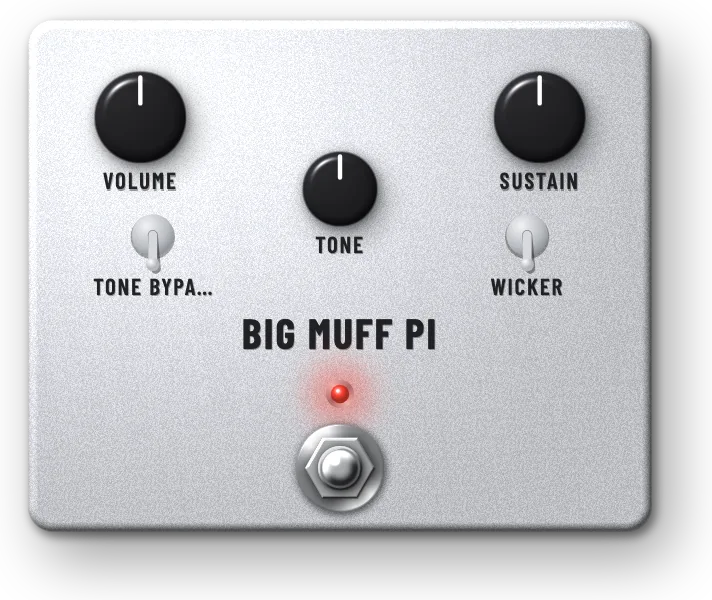
The real engine of the app, compiled for the browser, plays a recorded guitar (DI) through this pedal, then a clean amplifier and its cabinet. Turn the knobs (drag, scroll or use the arrow keys) and press the footswitch to hear it on and off. DI phrases by TONE3000, for now.
Four transistor stages, two of them clipping, around a tone control that scoops the middle. The New York board, as it is in the Tone Wicker: a switch takes the tone out, another takes the small feedback capacitors out for a brighter, noisier edge.
A wall. Play a power chord and it fills the room from the floor up, thick and smooth, the middle scooped out so that the lows push and the top fizzes. Hold a note and it sings, and keeps singing long after a clean note would have died: that is why the box says “sustainer”. Turn Sustain up and it gets denser and more compressed; turn Tone and you go from a dark, woolly roar to a cutting buzz. Two switches open it up further: one takes the tone control out for a fuller, louder sound, the other lets more hiss and bite through.
Its story
Electro-Harmonix was founded in New York by Mike Matthews in 1968. Early in 1969 it made the Muff Fuzz, a two-transistor box; by the end of that year came the Big Muff Pi, four transistors, co-designed with Bob Myer and sold as a “distortion/sustainer”. Matthews first sold it to Manny’s Music in New York, and Jimi Hendrix was among the first to buy one.
It has changed shape many times. The first, the “Triangle” (1969), put its three knobs in a triangle on a big grey box. The “Ram’s Head” of the early to mid-1970s is the one David Gilmour preferred. In the late 1970s an op-amp version replaced the four transistors; Billy Corgan used one on the Smashing Pumpkins’ Siamese Dream (1993). After Electro-Harmonix went bankrupt in 1984, the Big Muff was made in Russia from the early 1990s by Sovtek, in its “Civil War”, “Green Russian” and “Black Russian” cases, the ones Lee Ranaldo and Thurston Moore of Sonic Youth preferred. In 2000 Electro-Harmonix started making it in the United States again, with the NYC reissue, and in 2008 it released the Big Muff Pi with Tone Wicker, the same pedal with two switches added.
Carlos Santana, Jack White and J Mascis played it; in the mid-1990s the Smashing Pumpkins, Dinosaur Jr., NOFX and Bush did. Mudhoney named its 1988 EP Superfuzz Bigmuff after it.
The variant you play
It is the New York board of the Big Muff Pi with Tone Wicker, as mirosol traced it from a unit made in New York in 2013 and published it on freestompboxes.org. It is a tracing by someone else, not a document of Electro-Harmonix, and it may contain errors: its values were checked against eight captures of an NYC Big Muff by philvr on TONE3000, within 1 to 3 dB. One thing was changed from those captures: the Tone potentiometer’s two ends were the wrong way round (the sound at Tone 0.3 was the capture’s only with the knob at 0.7, and three other captures said the same), so they were swapped.
Four BC550C transistor stages: an input stage, two that clip through a pair of 1N4148 diodes each, and a recovery stage after the tone control, which is two filters, a low-pass and a high-pass, mixed by the Tone knob. Three knobs, Volume, Tone and Sustain, and the two switches of the Tone Wicker:
- Tone bypass takes the tone control out of the circuit: the full range goes through, and it is louder, since nothing makes up for the level the tone control was taking away (the op-amp Big Muffs of the late 1970s and early 1980s already had this switch; older tone bypasses had a resistor to make up the level, this one has none);
- Wicker takes out small capacitors that tame the hiss in the first three stages: brighter, more bite, more noise. The traced drawing does not say which ones its CMOS switch (a 4066) removes; here it is the three largest (430 pF, 470 pF, 470 pF), since the tracer’s text speaks of the small hiss-taming ones. That is a guess nothing has measured yet.
Both switches off is the original Big Muff Pi.
The pedal comes in two versions, picked from its menu on the board:
- Generic, the one the library gives you first: the transistors and diodes are generic SPICE models, reduced to a few figures (a gain of 590 for the transistors);
- Nexperia: the same circuit, with the transistors and the clipping diodes as their maker models them, the BC850C (the BC550C in a smaller case, the same chip and gain class) and the 1N4148 from Nexperia’s own SPICE files, unchanged. They know much more of how a real part behaves at high and low currents, and in return cost about eight times the computation. Use it if your machine has the room.
What is not the pedal:
- the switches: there is no switch in the netlist language, so each is a set of potentiometers moved together, at 0 or 1 only. Against the same circuit wired by hand they stay within 0.6 dB, about 0.3 dB of it a flat loss. The 4066’s own resistance is not modelled;
- the supply, an ideal 9 V battery, with the pedal’s protection diode and filter after it;
- the footswitch, left out.
To start
- Tone at noon, Sustain at noon, both switches off: the Big Muff as it has always been, and the setting that was measured most.
- Sustain up to 3 o’clock or more: denser, more sustain, more compressed.
- Tone bypass on: no scoop in the middle and a jump in level; bring the Volume down to match.
The circuit
One line per part: its name, the nodes it connects, its value (39k is
39 kΩ, 1u is 1 µF, 470p is 470 pF). A P line is a potentiometer
(its two ends, then the wiper between them). The Q lines are the
transistors (collector, base, emitter), the D lines the diodes, both
described at the end. The PW lines are the Wicker switch and the PB
lines the Tone bypass, each a set of resistors tied together by gang=.
This is the Generic version. The Nexperia version is the same line
for line, except that Q1 to Q4 become XQ1 to XQ4 (a BC850C
subcircuit: two transistors, a resistor and a diode), D1 to D4 become
XD1 to XD4 (a 1N4148 subcircuit with its leakage resistor), and the
two generic .model lines give way to Nexperia’s files. D5, the
supply’s protection diode, keeps its generic model.
Big Muff Pi
* EHX Big Muff Pi with Tone Wicker, NYC board (EC-D47), wicker off and tone on by default.
* Transcribed from the schematic traced by mirosol (freestompboxes.org, "EH BMP w/ Tone
* Wicker V.0.2", unit serial 20131003...). The tracing may contain errors: the values
* were checked against the eight NYC captures of philvr (TONE3000) within 1 to 3 dB;
* see .claude/skills/pedal-creator/SKILL.md, worked example 2.
* Sustain and Tone `pos` are the knob position, as the captures name them.
*
* The two switches are variable resistors on one gang each: a potentiometer has its
* wiper held to 0.1 % of its track at best, so a switch is a 1:1000 resistor, and what
* must be off is also shunted to ground. Position 0 or 1 only; against a netlist wired
* by hand they stay within 0.6 dB (about 0.3 dB of it a flat loss).
*   ToneBypass 0 = tone stack in circuit, 1 = out of it (the bypass has no resistor).
*   Wicker     0 = the three feedback caps of the first three stages, 1 = they are out.
* Which capacitors the 4066 takes out is NOT in the traced drawing: the three largest
* (430 pF, 470 pF, 470 pF), as the author's text says the small hiss-taming ones, is
* a hypothesis nothing measured yet. The 4066's own on resistance is not modelled.
V1 in 0 DC 0
* supply: 9 V, reverse-protection diode D5, R25 and C14 filter
VB vbat 0 DC 9
D5 vbat vd d_1n4002
R25 vd vcc 120
C14 vcc 0 220u
* stage 1
R24 in 0 2.2e6
R2 in a 39k
C1 a b1 1u
R14 b1 0 100k
Q1 c1 b1 e1 q_bc550c
R22 e1 0 120
R13 vcc c1 10k
R9 c1 b1 470k
C10 x1 b1 430p
C19 c1 b1 27p
C21 c1 b1 10p
* sustain
C4 c1 s1 0.47u
PSustain s1 w s2 100k taper=log pos=0.5
R1 s2 0 560
* stage 2 (clipping)
C5 w d2 1u
R19 d2 b2 10k
R20 b2 0 100k
Q2 c2 b2 e2 q_bc550c
R16 e2 0 120
R18 vcc c2 10k
R17 c2 b2 470k
C12 x2 b2 470p
D1 b2 m2 d_1n4148
D2 m2 b2 d_1n4148
C6 m2 c2 1u
* stage 3 (clipping)
C13 c2 g3 1u
R12 g3 b3 10k
R21 b3 0 100k
Q3 c3 b3 e3 q_bc550c
R10 e3 0 120
R11 vcc c3 10k
R15 c3 b3 470k
C11 x3 b3 470p
D3 b3 m3 d_1n4148
D4 m3 b3 d_1n4148
C7 m3 c3 2.2u
* tone
C8 c3 t 2.2u
C9 ti p1 3.3n
R5 p1 0 27k
R8 ti p2 27k
C15 p2 0 10n
PTone p1 tw p2 100k taper=lin pos=0.5
* recovery stage and volume
C3 x b4 0.47u
R3 b4 0 100k
Q4 c4 b4 e4 q_bc550c
R4 e4 0 2.2k
R6 vcc c4 10k
R7 c4 b4 470k
C2 c4 vt 1u
PVolume vt out 0 500k taper=log pos=0.5
* switches (kept last: the controls are numbered in netlist order)
PWs1 c1 c1 x1 3e6 gang=Wicker pos=0
PWh1 x1 wsh wsh 3e6 gang=Wicker pos=0
PWs2 c2 c2 x2 3e6 gang=Wicker pos=0
PWh2 x2 wsh wsh 3e6 gang=Wicker pos=0
PWs3 c3 c3 x3 3e6 gang=Wicker pos=0
PWh3 x3 wsh wsh 3e6 gang=Wicker pos=0
Cwsh wsh 0 10u
PBi t t ti 3e5 gang=ToneBypass pos=0
PBo tw tw x 1e5 gang=ToneBypass pos=0
PBp1 t mb mb 1e6 gang=ToneBypass pos=0
PBp2 mb x x 1e6 gang=ToneBypass pos=0
PBs mb mb 0 1e6 gang=ToneBypass pos=0
.model d_1n4148 D(IS=2.52e-9 N=1.752e0)
.model d_1n4002 D(IS=14.11e-9 N=1.984e0)
.model q_bc550c NPN(IS=1e-14 BF=5.9e2 BR=1e0)
.input V1
.output out
Measured against
Fourteen captures of two New York Big Muffs on TONE3000, all with Tone at noon and both switches off: eleven of an NYC Big Muff Pi (“EHX Big Muff Pi NYC”, Sustain from its lowest to its highest), and three of a Big Muff made in New York in the 1990s, by daniel8381 (“BIG MUFF Made in USA”). Neither is a Tone Wicker: with both switches off, it is their circuit. These captures are not ours to share: we name them, we do not distribute them. A knob “at 7 o’clock” is 0, “at 5 o’clock” is 1, each hour 0.1.
| Capture | Sustain | Tone | Volume |
|---|---|---|---|
| EHX Big Muff Pi NYC, 1-BigMuff_V3o’clock_T12o’clock_S7o’clock | 0.0 | 0.5 | 0.8 |
| EHX Big Muff Pi NYC, 2-BigMuff_V3o’clock_T12o’clock_S8o’clock | 0.1 | 0.5 | 0.8 |
| EHX Big Muff Pi NYC, 3-BigMuff_V3o’clock_T12o’clock_S9o’clock | 0.2 | 0.5 | 0.8 |
| EHX Big Muff Pi NYC, 4-BigMuff_V2o’clock_T12o’clock_S10o’clock | 0.3 | 0.5 | 0.7 |
| EHX Big Muff Pi NYC, 5-BigMuff_V2o’clock_T12o’clock_S11o’clock | 0.4 | 0.5 | 0.7 |
| EHX Big Muff Pi NYC, 6-BigMuff_V1o’clock_T12o’clock_S12o’clock | 0.5 | 0.5 | 0.6 |
| EHX Big Muff Pi NYC, 7-BigMuff_V1o’clock_T12o’clock_S1o’clock | 0.6 | 0.5 | 0.6 |
| EHX Big Muff Pi NYC, 8-BigMuff_V1o’clock_T12o’clock_S2o’clock | 0.7 | 0.5 | 0.6 |
| EHX Big Muff Pi NYC, 9-BigMuff_V12o’clock_T12o’clock_S3o’clock | 0.8 | 0.5 | 0.5 |
| EHX Big Muff Pi NYC, 10-BigMuff_V12o’clock_T12o’clock_S4o’clock | 0.9 | 0.5 | 0.5 |
| EHX Big Muff Pi NYC, 11-BigMuff_V12o’clock_T12o’clock_S5o’clock | 1.0 | 0.5 | 0.5 |
| BIG MUFF Made in USA, BIG MUFF V3 T12 S8 -18db | 0.1 | 0.5 | 0.5 |
| BIG MUFF Made in USA, BIG MUFF V3 T12 S12 -18db | 0.5 | 0.5 | 0.5 |
| BIG MUFF Made in USA, BIG MUFF V3 T12 Sfull -18db | 1.0 | 0.5 | 0.5 |
daniel8381’s captures do not give the Volume (“V3” is the pedal’s version): it is set at 0.5. The last of them and the eleventh NYC capture are the same setting, so the fourteen captures make thirteen settings.
Neither pack says the level that went in. One voltage per pack was fitted once, on the Sustain-at-noon capture, then held for all the others: a full scale of 1.7 V for the NYC pack and 0.7 V for daniel8381’s.
Its grade
Bronze, score 63.3. The maths is right (it follows ngspice at −44.6 dB at 48 kHz and −65.2 dB at 192 kHz), its five controls behave, and on a guitar take:
| Capture | Sustain | Difference (pre-emphasised ESR) | Disturbed frames | PEAQ (ODG) |
|---|---|---|---|---|
| NYC 1 | 0.0 | −8.38 dB | 23.95 % | −2.539 |
| NYC 2 | 0.1 | −6.57 dB | 7.26 % | −0.981 |
| NYC 3 | 0.2 | −5.05 dB | 4.37 % | −0.988 |
| NYC 4 | 0.3 | −4.40 dB | 5.60 % | −1.103 |
| NYC 5 | 0.4 | −4.08 dB | 5.44 % | −1.121 |
| NYC 6 | 0.5 | −3.99 dB | 6.18 % | −1.216 |
| NYC 7 | 0.6 | −2.57 dB | 1.07 % | −1.785 |
| NYC 8 | 0.7 | −4.21 dB | 0.74 % | −1.951 |
| NYC 9 | 0.8 | −3.62 dB | 1.81 % | −2.390 |
| NYC 10 | 0.9 | −2.21 dB | 3.38 % | −2.263 |
| NYC 11 | 1.0 | −2.64 dB | 4.70 % | −2.987 |
| Made in USA S8 | 0.1 | −11.24 dB | 70.83 % | −3.761 |
| Made in USA S12 | 0.5 | −5.83 dB | 4.62 % | −0.986 |
| Made in USA Sfull | 1.0 | −1.22 dB | 22.49 % | −3.643 |
None of the thirteen settings is close, and that is what holds it at bronze. A close setting needs both a difference of −10 dB or better and a PEAQ grade of −2 or better. Eight of them pass the PEAQ test (−0.981 to −1.951, Sustain from 0.1 to 0.7), but their difference is between −2.57 and −6.57 dB. The only one past −10 dB, daniel8381’s at Sustain 0.1, is far by PEAQ (−3.761).
When the grade was first recorded (score 61, before the logarithmic potentiometers were corrected to follow a datasheet’s law, which brought it to 63.3), the measurement found where it differs. The compression is right: within 0.2 to 0.4 dB at the nine NYC settings away from the ends of Sustain. The treble is not: the pedals have 3 to 4 dB more than the circuit above about 4 kHz, and from 1 kHz up at Sustain’s lowest. Ruled out: the Wicker capacitors (taking them out overshoots by 15 to 35 dB) and the simulation itself (48 and 192 kHz agree within −21 dB on the guitar take). Near the ends of Sustain the two packs disagree with each other, so the reading of a logarithmic knob there is uncertain. On philvr’s captures, with Tone fully up and Sustain low, it went the other way: above 5 kHz the capture was 5 to 7 dB under the circuit. Neither is explained yet, and nothing in the circuit was changed to hide it.
The Nexperia version has no grade of its own: it has not been measured yet.
Sources: Big Muff (Wikipedia), Electro-Harmonix, Big Muff Pi with Tone Wicker, mirosol, EHX Big Muff Pi with Tone Wicker, TONE3000, EHX Big Muff Pi NYC, TONE3000, BIG MUFF Made in USA by daniel8381, TONE3000, EHX NYC Big Muff Pi 2000s - Expanded by philvr.